Acute Cholangitis Survey Update
Acute Cholangitis Survey Update
Global PSC Survey
Initial Results
What was the acute cholangitis in PSC survey about?
Acute cholangitis is a serious and potentially dangerous complication of primary sclerosing cholangitis (PSC) that occurs when the bile ducts become infected or blocked. While it is known that these episodes cause a wide range of difficult symptoms, the exact patterns of these symptoms and how they affect an individual’s recovery are not fully understood.
This survey aims to identify distinct patterns or ‘groups’ of symptoms during a flare-up and find out if these patterns link to how well or how quickly someone recovers.
In the longer term, we want this project to raise the profile of this serious complication and improve access to the right care when cholangitis is suspected.
Can I still complete the survey?
Yes! In partnership with ERN RARE-LIVER, the survey is available in twelve languages and is still open. This is truly a global collaboration!
How was it done?
The survey was originally created and distributed by two patient charities: PSC Support in the UK and PSC Partners in the US. And we shared the initial analysis at the EASL research congress in Barcelona.
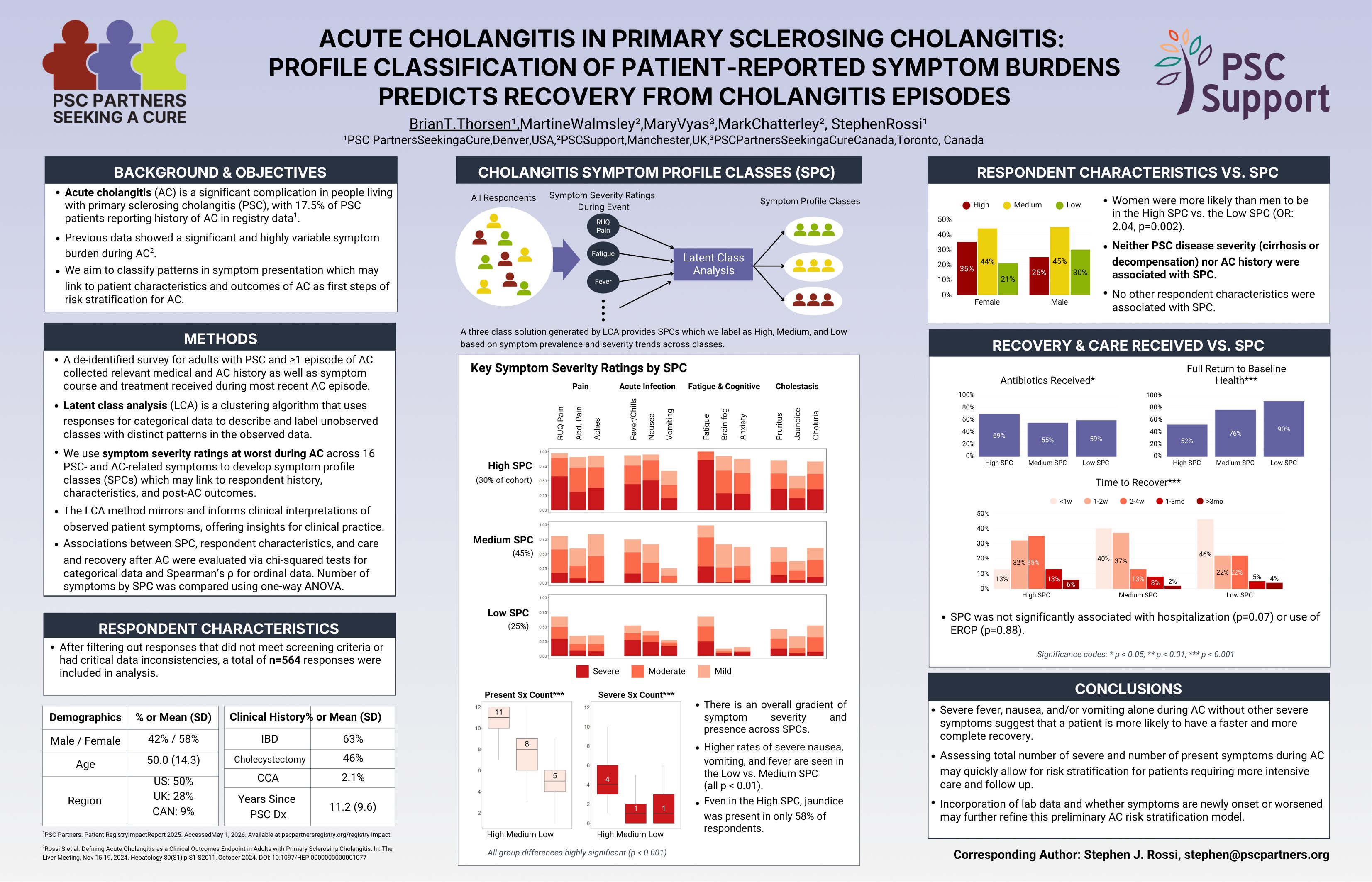
We collected data from 564 adults with PSC who had had one or more episodes of acute cholangitis. The questions covered their specific symptoms (such as fever, liver pain, fatigue, itching, nausea, jaundice, anxiety, and depression), what medical treatments they received, and how long it took them to get better. PSC Partners conducted the statistical analysis, and grouped respondents into different ‘symptom profile classes’ based on how severe their symptoms were.
What were the key findings?
- Common Symptoms: During a flare-up, almost all symptoms were reported by more than half of the patients. Extreme tiredness (fatigue) was the most common symptom, affecting 90% of people, followed closely by liver pain at 84%.
- Three Levels of Severity: We found that patients naturally fell into three main groups based on their symptom patterns:
- The High Group (30% of patients): These individuals had the most severe and widespread symptoms. Every single person in this group had moderate-to-severe fatigue, and more than three-quarters suffered from moderate-to-severe liver pain, fever, nausea, loss of appetite, and sleep problems.
- The Medium Group (45% of patients): These individuals had moderate symptom levels. For example, 66% experienced brain fog.
- The Low Group (25% of patients): These individuals generally had fewer symptoms overall (only 12% had brain fog). Interestingly, though, they still had high rates of severe liver pain, fever, and vomiting, meaning a ‘low’ overall classification does not mean the episode was easy.
- Impact on Recovery: How bad an individual’s symptoms were directly predicted how well they recovered after the infection.
- In the Low group, most (90%) of respondents made a full recovery back to their baseline health.
- In the Medium group, three quarters (76%) fully recovered.
- In the High group, only around half (52%) made a full recovery, and their recovery times were significantly longer.
- Key Demographics and Indicators: Women were more likely to fall into the High symptom group than the Low group. Additionally, having a fever and nausea alone during a flare-up usually pointed to a milder, more treatable case with a very strong chance of a full recovery. Neither disease severity or previous history of cholangitis attacks was associated with the level of acute cholangitis severity.
So what does all this mean?
There is a clear link between the total burden of symptoms a patient experiences during acute cholangitis and their ultimate ability to bounce back.
However, the survey results support what we already suspect: acute cholangitis is hard to recognise because:
- the symptoms of acute cholangitis are multiple and vary from person to person
- the severity of the acute cholangitis episode doesn't relate to the stage of someone's disease or previous episodes.
Symptoms are important to track when you suspect you're having a cholangitis episode. In the future, recognising symptom patterns could help doctors better understand the severity of a episode, tailor treatments, and predict who might need extra support during a longer recovery period. However, it's too early to draw any concrete conclusions.
If you haven't taken part in the survey yet and you've had cholangitis in the past, PLEASE do. It is currently available to complete in 12 languages. If you have taken the survey - thank you.
Reference
Thorsen B, Walmsley M, Vyas M, Chatterley M, Rossi S. SAT-412 Acute cholangitis in primary sclerosing cholangitis: profile classification of patient-reported symptom burdens predicts recovery from cholangitis episodes. Journal of Hepatology. 2026 May 1;84:S346.
More EASL 2026 News
For more news from the 2026 EASL Liver Research Congress, register for our Ask the Expert scheduled for 7pm 25 June 2026 with Professor Palak Trivedi, and check out the news posts below: