A pilot study reveals blocking the IL-17 pathway is safe and feasible for primary sclerosing cholangitis
Promising early results from SABR-PSC pilot study on brodalumab
EASL Congress News
Dr Amera Elzubeir
What was the study about?
There are currently no licensed medical treatments available to cure or slow down primary sclerosing cholangitis (PSC). However, laboratory science suggests that a specific part of our immune system, called the Interleukin-17 (IL-17) pathway, is actively involved in causing the inflammation seen in PSC.
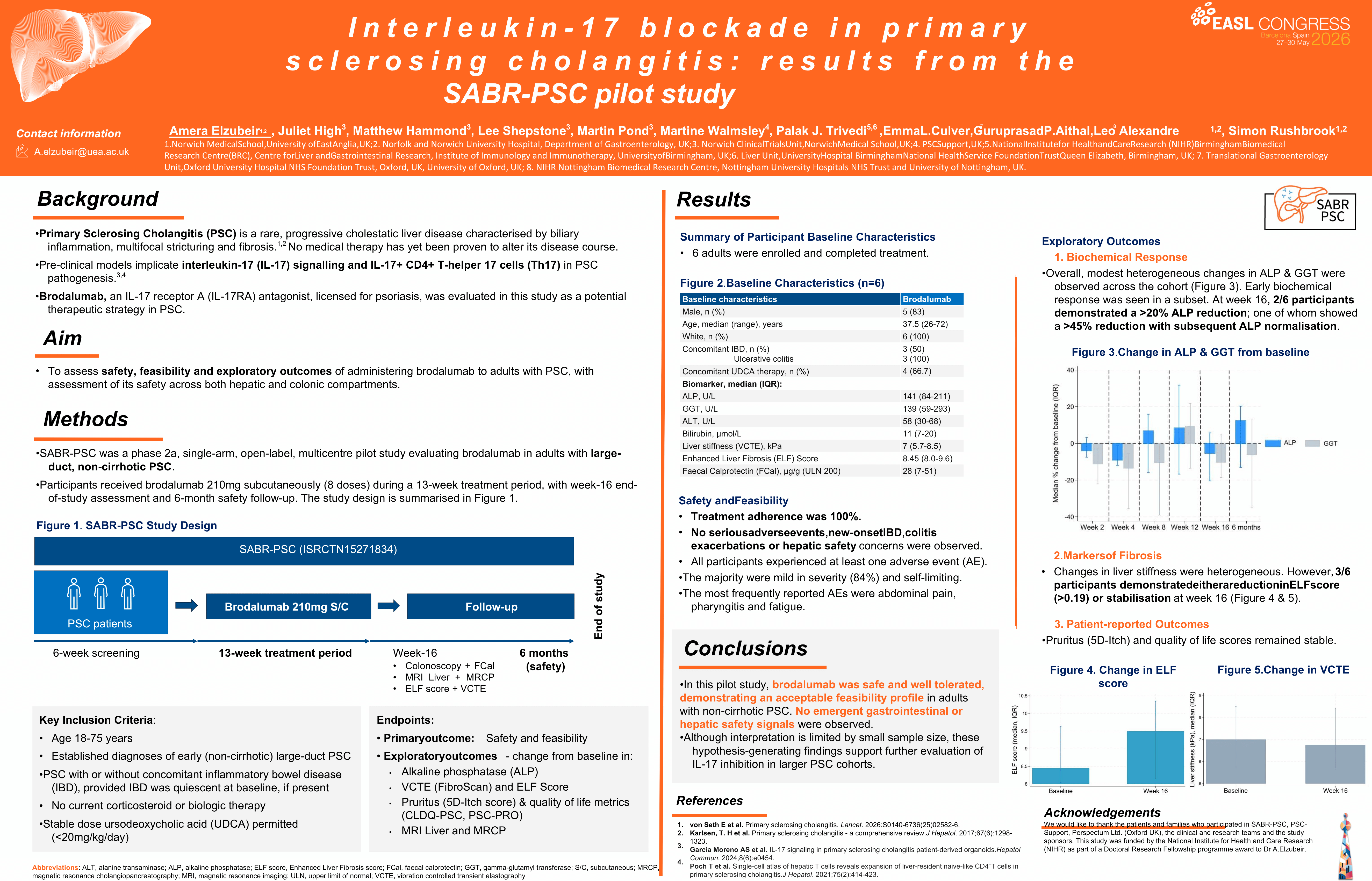
This small pilot study (called SABR-PSC, led by Dr Amera Elzubeir) was designed to see if a drug called brodalumab, which works by blocking this specific IL-17 immune pathway, is safe, feasible, and well-tolerated for people living with large-duct PSC. Dr Elzubeir presented the results to the international research congress held last month (EASL) in Barcelona.
How was it done?
This was a small, multi-centre, ‘open-label’ study, meaning both the researchers and the patients knew they were receiving the active medication.
- Participants: 6 adults with PSC took part. Their median age was 37.5 years, the majority were male, and half of them also had inflammatory bowel disease (IBD) that was currently inactive (quiescent).
- Treatment: Each person received 8 injections of brodalumab just under the skin (subcutaneously) over a period of 13 weeks.
- Monitoring: Dr Elzubeir closely monitored safety, side effects, and how well the patients stuck to the treatment. They also looked at liver blood tests, specifically alkaline phosphatase (ALP), liver scarring scores (ELF and Fibroscan), and overall quality of life.
What were the key findings?
- Excellent Feasibility: Every single participant completed the study, and there was 100% adherence to the injection routine.
- Good Safety Profile: While all participants experienced at least one side effect, the vast majority of these were mild. The most common side effects reported were fatigue, sore throats, and abdominal pain. Importantly, there were no serious adverse events.
- No IBD Flare-ups: Because blocking the IL-17 pathway can sometimes trigger or worsen bowel inflammation, Dr Elzubeir closely checked the participants' colons using post-treatment colonoscopies and tissue samples. Reassuringly, no new diagnoses or flare-ups of IBD were seen.
- Encouraging Early Signs in Some Patients: While this trial was too small to officially prove effectiveness, a couple of participants showed notable improvements by week 16:
- Two out of the six patients (33%) saw their ALP liver enzyme levels drop by more than 20%, alongside improvements in their liver scarring scores.
- One of these individuals experienced a major drop in ALP of over 45%, bringing their liver blood tests back down into the normal range.
- These positive changes appeared to be more pronounced in patients who started the study with higher baseline liver scarring scores.
- Symptoms and Quality of Life: Patients' scores for itch severity and general health-related quality of life remained stable throughout the study.
Conclusion
This first-of-its-kind pilot study demonstrates that blocking the IL-17 pathway with brodalumab is a safe, highly tolerable, and practical approach for people with PSC, without causing any unwanted bowel issues. Because of these encouraging early results and improvements in a subset of patients, a much larger, randomised controlled trial is needed to determine whether this drug can safely and effectively treat PSC.
Reference
Elzubeir A, High J, Hammond M, Shepstone L, Walmsley M, Trivedi P, Culver E, Aithal G, Alexandre L, Rushbrook S. SAT-270 Interleukin-17 blockade in primary sclerosing cholangitis: results from a single-arm, open-label pilot study. Journal of Hepatology. 2026 May 1;84:S311.
More EASL 2026 News
For more news from the 2026 EASL Liver Research Congress, register for our Ask the Expert scheduled for 7pm 25 June 2026 with Professor Palak Trivedi, and check out the news posts below: