Redefining Clinical Care: PSC Support Champions Patient-Centred Approaches at International Roundtable
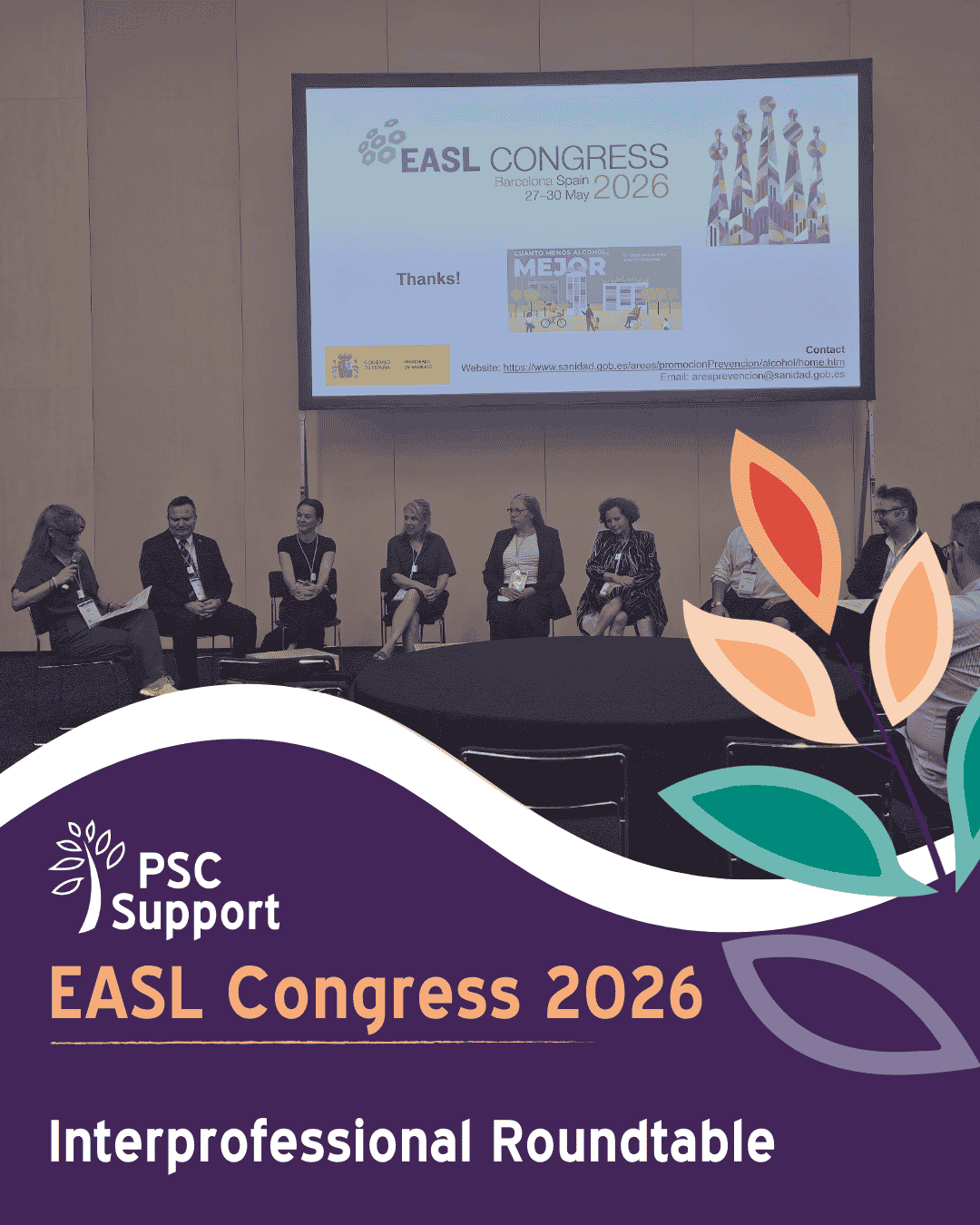
Round Table Discussion at EASL 2026
Patient-Centred Care and Research
Wednesday 27th May, Barcelona
Summary
Martine Brown (née Walmsley) represented PSC Support and ERN RARE-LIVER at an Interprofessional Roundtable alongside Chief Executives from leading international patient organisations (including Liver Patients International, the European Liver Patients’ Association, and Digestive Cancers Europe) and eminent clinical experts in the field of hepatology, including Professor Geoffrey Dusheiko and Dr Richard Parker.
Martine's contributions focused on challenging the current clinical status quo, addressing the structural disadvantages faced by the rare disease community, and advocating for a shift from clinical consultation to genuine co-production. This active participation demonstrated PSC Support’s leadership in international policy and patient advocacy.
Key Contributions and Strategic Viewpoints
1. Patient-Centred Care: Shifting from Organ to Person
Martine challenged the traditional clinical model of treating the disease rather than the whole person. While a patient may present with stable blood test results in a clinical setting, the lived reality at home can be vastly different, often leaving them unable to work or maintain daily functioning.
Martine highlighted that research often revolves around regulatory requirements to secure a pharmaceutical licence rather than the lived reality of helping patients live a full life.
Martine urged a shift in focus from measuring how a patient feels about a specific treatment to identifying the exact daily problems the medicine should be solving.
In short, clinical care currently revolves around the organ, whereas it must also revolve around the person.
2. Clinical Trial Endpoints: Biomarkers vs. Quality of Life
In discussing clinical trial design, Martine addressed the significant disconnect in hepatology today: treating laboratory results while the patient continues to suffer.
The system currently measures what is statistically significant rather than what is clinically significant. A clinical trial may successfully demonstrate that a drug lowers liver blood tests or reduces fibrosis in liver tissue samples, yet the patient remains too fatigued to hold down a job or too nauseous to enjoy a meal. For a patient, this is not a success.
Because biomarkers serve as primary endpoints, quality of life and fatigue metrics are frequently relegated to secondary or exploratory endpoints, meaning trials lack the statistical power to draw strong conclusions. A biomarker is merely a proxy for a condition, whereas quality of life is the actual reality. For PSC, we must look to quality of life in the absence of reliable individual surrogate biomarkers.
3. Real-World Evidence in Rare Diseases
Addressing the challenges of conducting traditional randomised controlled trials (RCTs) within rare disease populations, Martine strongly advocated for the legitimisation and standardisation of Real-World Evidence (RWE).
In rare conditions, a gold-standard RCT can be a statistical impossibility (because there are fewer patients and uncertain endpoints); rejecting RWE means being exclusionary rather than rigorous. We must weigh the risk of data bias against the far greater risk of doing absolutely nothing.
While RCTs demonstrate whether a drug works under perfect conditions, RWE evaluates sustainability, including treatment burden, impact on daily functioning, and long-term side effects. However, we need to collect data in a structured way to regulatory standards, and regulators need to provide guidance about what is an acceptable RWE standard.
4. Structuring Guidelines
One patient organisation highlighted that they were not included in a new European guideline development and that patients were excluded. Martine countered that using the UK PSC guidelines as an example, currently under development. Our experience at PSC Support is very different. Not only are we included, we are included at the very first stage and are defining the initial research questions in the guideline. We are very grateful for the support of the PSC clinical and research community over the past two decades.
5. Recommended Structural Change
When asked to identify the single most impactful change required in medicine development and clinical guidance, Martine called for the formalisation of patient involvement at the absolute inception of the process. We must stop treating the patient voice as a 'polite addition' at the end of a project and make it a structural requirement at the start. We need to move from 'Consultation' to 'Co-Production' by putting patients in charge of defining the outcomes we measure.
More EASL 2026 News
For more news from the 2026 EASL Liver Research Congress, register for our Ask the Expert scheduled for 7pm 25 June 2026 with Professor Palak Trivedi, and check out the news posts below: