January 2026 Research Roundup
BASL Immune Special Interest Group Meeting
22 January 2026

Last week I attended a BASL Immune Special Interest Group (SIG) meeting, led by its Chair, Professor Palak Trivedi. The Immune SIG is a dedicated sub-group within BASL, which is the national association for hepatology in the UK. It focuses on immune-mediated diseases like PSC.
This meeting highlighted important progress in research and care, and on new medications for autoimmune liver diseases. The focus was on creating standardised care models to improve the quality of care that patients receive, alongside announcing new services for PSC patients.
Key developments include the validation of ‘care bundles’ for primary biliary cholangitis (PBC) and autoimmune hepatitis (AIH), the licensing of inebilizumab for IgG4-related disease (IgG4-RD), and the EMPHATIC pilot evaluation for liver transplant in individuals who have PSC and bile duct cancer (cholangiocarcinoma, CCA).
Attendees included pharmaceutical companies, patient groups and clinicians.
What did we learn?
Dr Emma Culver (John Radcliffe Hospital, Oxford): IgG4-related disease (IgG4-RD) management has progressed with the FDA approval of a medicine called inebilizumab, making it the first approved drug for this condition. There is a national infrastructure, including a specialised Multidisciplinary Team (MDT), registry and biobank, that supports the management of complex cases.
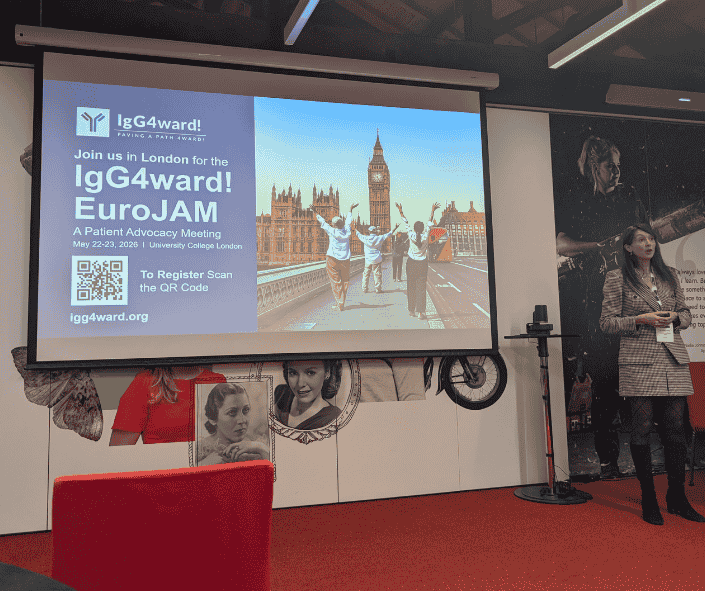
There's also a patient organisation for people with IgG4-RD called IgG4ward! They are having a patient meeting in (a EUROJAM) London in May.
Dr Shanika Nayagam (King’s College Hospital, London): Transitional care for young people aged 16 to 25 is a critical period where risk factors such as finding it tricky to take medications, mental health issues, and substance abuse (e.g., ketamine) are common.
The team at King’s and other hospitals have dedicated multidisciplinary transition teams to support young people living with PSC (and other liver diseases). However, there are many hospitals (with willing and capable teams) without the infrastructure to support young people’s care.
The team at King's is working to identify healthcare professionals (HCPs) with an interest in the care of young people with liver disease and define the minimum information needed for shared care documents and the creation of resources on childhood liver diseases for adult HCPs.
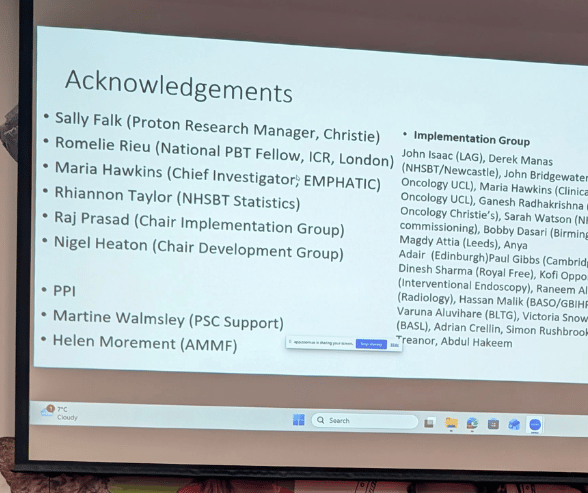
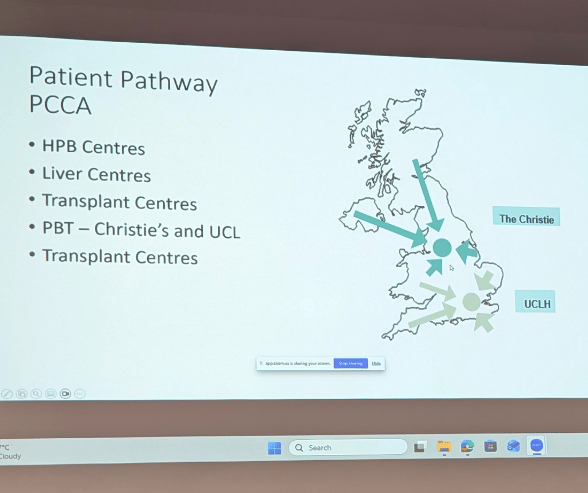
Professor Douglas Thorburn (Royal Free Hospital, London): The EMPHATIC program is a national pilot evaluating liver transplant for PSC patients with a certain type of bile cancer (perihilar CCA) who meet specific criteria, including a tumour mass under 3cm. This pathway involves having Proton Beam Therapy (PBT) at either Christies in Manchester or the UCL in London and chemotherapy. Until now, these circumstances led to an immediate disqualification from having a liver transplant in the UK.
If you'd like to know more, Mark will be on a webinar with AMMF to talk about EMPHATIC on 11 February at 18:00. Register here.
Professor Palak Trivedi (University Hospital, Birmingham): Professor Trivedi updated the meeting on the work that has arisen from the UK-PSC registry. For example, the UK-PSC data reveals that itch severity in PSC is associated with advanced liver disease and cirrhosis (liver damage), distinct from the pattern seen in PBC.
Active trials include Asp-PSC (Aspirin for cancer prevention), FARGO (Faecal Microbiome Transplantation - poo transplants), and CATCH (carbon nanopore beads that mop up toxins). You can find out more about these on our Take Part in Research page.
Dr Rachel Smith (Addenbrooke's Hospital, Cambridge) and Dr Jessica Dyson (Newcastle's Freeman Hospital) talked about the ‘care bundles’.
What’s a care bundle? It is a ‘cheatsheet’ for healthcare teams to follow to ensure every patient with a particular disease gets the same high standard of care and monitoring.
The use of the PBC care bundle has been shown to significantly improve standards of care in pilot hospitals, increasing second-line therapy referrals to 94% and symptom assessments to 90%. A similar AIH care bundle is under development to standardise treatment (as far as is possible in AIH), and address symptom side effects. PSC Support is working with Dr Deepak Joshi to develop a PSC care bundle. Watch this space!
It’s easy to look at a room full of researchers and clinicians and think it’s just a talking shop. But for us, being at the BASL Immune SIG is where the hard work of advocacy happens. It’s about making sure that when doctors and scientists plan the future of liver care, the PSC community has a seat at the table.
Here is what we are taking away from this meeting and turning into action:
Quality care, everywhere
We know that care for PSC can be patchy, with great care here and not great care elsewhere. We saw how ‘care bundles’ (basically a high-quality checklist for doctors) have transformed outcomes for PBC patients.
- What we’re doing: We are now working directly with Dr. Deepak Joshi to create a PSC Care Bundle.
- The goal: We want to make sure people with PSC get the right monitoring for everything from itch and fatigue to cancer surveillance, no matter which hospital you’re in.
Supporting our young people
PSC affects people of all ages, and can be diagnosed in childhood. The jump from children’s services to adult care (ages 16–25) is a really vulnerable time. It’s a period where it’s easy to feel lost in the system.
- What we’re doing: We fully support the efforts to bridge services and develop clearer paperwork between different services and hospitals.
- The goal: To make sure every young person has the psychological support and the right team behind them so they don’t feel like they’re starting from scratch in the adult clinic.
Making clinical trials smarter (and faster)
We all want treatments, and we want them yesterday. To get drugs approved, we need to prove they work using data that regulators trust.
- What we’re doing: We’re advocating for the use of ‘Real-World Evidence’. This could be using data from the UK-PSC registry or PSC Partners’ WIND project to help prove a drug’s worth, rather than relying solely on very long, traditional trials.
- The goal: To get safe, effective treatments into patients’ hands as quickly as possible.
These meetings are where the future of PSC care is mapped out. We are in the room to make sure that as new clinical standards and research priorities are set, they actually reflect your lived experience. Part of our job at PSC Support is to bridge the gap between clinical research and the patient’s reality. By being at the table, we ensure that the UK’s leading liver specialists are focused on what matters most to you: faster diagnosis, better symptom management, and ultimately, a cure.
Do drop me an email if you have any questions:
Martine Walmsley
PSC Support Head of Research Strategy
ERN RARE-LIVER Management Board and PSC Working Group Co-Lead