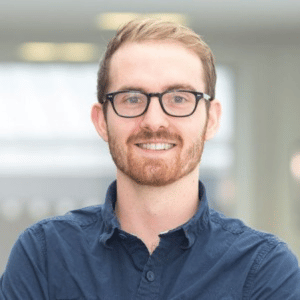
Dr Edward Jarman
Detection and characterization of early immune-responsive epithelial cell states in the transition from PSC to CCA

Awarded to Dr Edward Jarman, University of Edinburgh
The total grant awarded is £50,000
Duration of award: 3 years (Sep 2023 to Aug 2026)
Research title: Mapping cell states associated with tumour initiation phenotypes onto PSC for the early identification and characterization of epithelial and immune state changes associated with CCA risk in PSC patients.
Summary
PSC Support has awarded £50,000 to Dr Edward Jarman to investigate how the cells in people with PSC can develop into bile duct cancer (cholangiocarcinoma). He will do this by using cutting-edge technology to look at the key cellular and microenvironmental changes that take place in PSC that contribute to the development of tumours.
The potential impact of understanding these changes could be huge for patients. The hope is that this research will find signs to identify which people with PSC are at risk of developing bile duct cancer, early signs of the cancer, and the first steps to developing a medicine to prevent early bile duct cancer from growing in people with PSC.
Background
In a series of experiments using cutting edge technology, Dr Jarman will study cells that are becoming cancerous in people with PSC and mice. He wants to deeply understand the processes at work in cells as they change and start to become cancers.
What will Dr Jarman do?
In a series of experiments using cutting edge technology, Dr Jarman will study cells that are becoming cancerous in people with PSC and mice.
Why is this study important?
Dr Jarman’s research will tell us how common cancer-forming cells are in people with PSC and tell us whether these cells are changing the immune system to help their growth. It will give us insights into whether these changes are indicators of cancer risk in people with PSC or even avenues for medicines to prevent early bile duct cancer forming into tumours.
This study addresses a critical research area for people with PSC: “Identifying warning signals that I may get cancer” and has the potential to lead to medicines to prevent or treat the cancer early.
Although the risk of getting bile duct cancer is small, the impact of getting this cancer is huge. One of the most difficult aspects of living with PSC is dealing with an unpredictable disease and an uncertain future. Some people even describe it as, ‘living with a ticking time bomb inside me.'
Removing or reducing this risk would alleviate some of this very real emotional burden and fear.
Research update 2
“By modelling the progression of primary sclerosing cholangitis into cholangiocarcinoma we have been able to identify a signature from cells undergoing this transition. We have identified COX2 as a marker of this process and have been able to demonstrate that a subset of patients with PSC have COX2 positive cells in their bile ducts.
The expression of COX2 correlates in these patients to immune signatures we see in our model, suggesting an equivalence between mechanisms we are currently defining in this system and the reality of patients with PSC.
I am proud to say that this represents an appreciable leap forward with regards to the aims of this project to define mechanisms of PSC-CCA transition and to determine whether signs of these early changes are detectable in PSC patients.”
Dr Edward Jarman, November 2025
Research update 1
"So far in the project we have successfully generated our mouse biliary organoid models. These have P53 and/or Pten gene knockout which we have induced using a lentiviral CRISPR-cas9 approach. The single and double knockout lines have been validated and are currently being assessed for the expression of immunogenic biliary epithelial markers in response to mutation.
"These organoid lines will not only be used to assess the roles of P53 and Pten in driving immunogenic gene expression in biliary epithelial cells, but are also fundamental to our orthotopic approach in mice, which we are swiftly working towards. We have been assessing which of these markers appear specific to mutant epithelial cells at the protein level in murine liver tissue, which could act as useful markers in patient tissue."
Dr Edward Jarman, October 2024
Mission 2030 is an ambitious challenge and we can’t do it alone. We need your help to find the breakthrough people with PSC so desperately need.
It’s time we found effective treatments for PSC
Play your part in leaving no stone unturned
Make a donation to research and all the other things we do to help people affected by PSC