PSC Support Research Funding Programme
How to apply for research funding for PSC research
Mission 2030
By 2030, we will fund and support more PSC research than ever before, offering over £1 million in grants to researchers to:
- fund PSC studies aligned with our Research Strategy, turning researchers’ ideas into reality; and
- fund 3-4 year PhD clinical fellowships in PSC to help develop the careers of future PSC specialists and to fill the critical gaps in our knowledge about PSC
Apply for 2026 Funding
PSC Support welcomes grant applications for PSC-related research. As a member of the Association of Medical Research Charities, PSC Support employs strict peer review processes to ensure we fund only the highest quality research that advances our understanding of PSC and accelerates the development of effective tools, treatments, and care.
Note on Disease Scope: All applications must focus primarily on primary sclerosing cholangitis (PSC), recurrent PSC (rPSC), cholangiocarcinoma (CCA) with PSC, or inflammatory bowel disease with PSC (PSC-IBD).
How to Apply
Deadlines updated 18 August 2026
We operate a two-stage application process for our research grant calls:
Stage 1: Letter of Intent (LOI)
Applicants must submit a concise Letter of Intent (LOI) via our online Grant Portal. LOIs undergo administrative triage to confirm eligibility, budget adherence, and fit with our strategic priorities.
- LOI Call Opens: 01 Aug 2026
- LOI Submission Deadline: 30 Sep 2026, 23:59 (BST)
Stage 2: Full Application (By Invitation Only)
Applicants whose LOIs pass initial triage will be invited to submit a full grant application by 06 November 2026. Full applications undergo rigorous peer review by independent scientific experts and patient reviewers, followed by assessment by our Scientific Review Committee.
Access our Grant Portal
Ready to start your submission? Click below to access our online application system. First-time users will need to register an account.
Available Awards in 2026
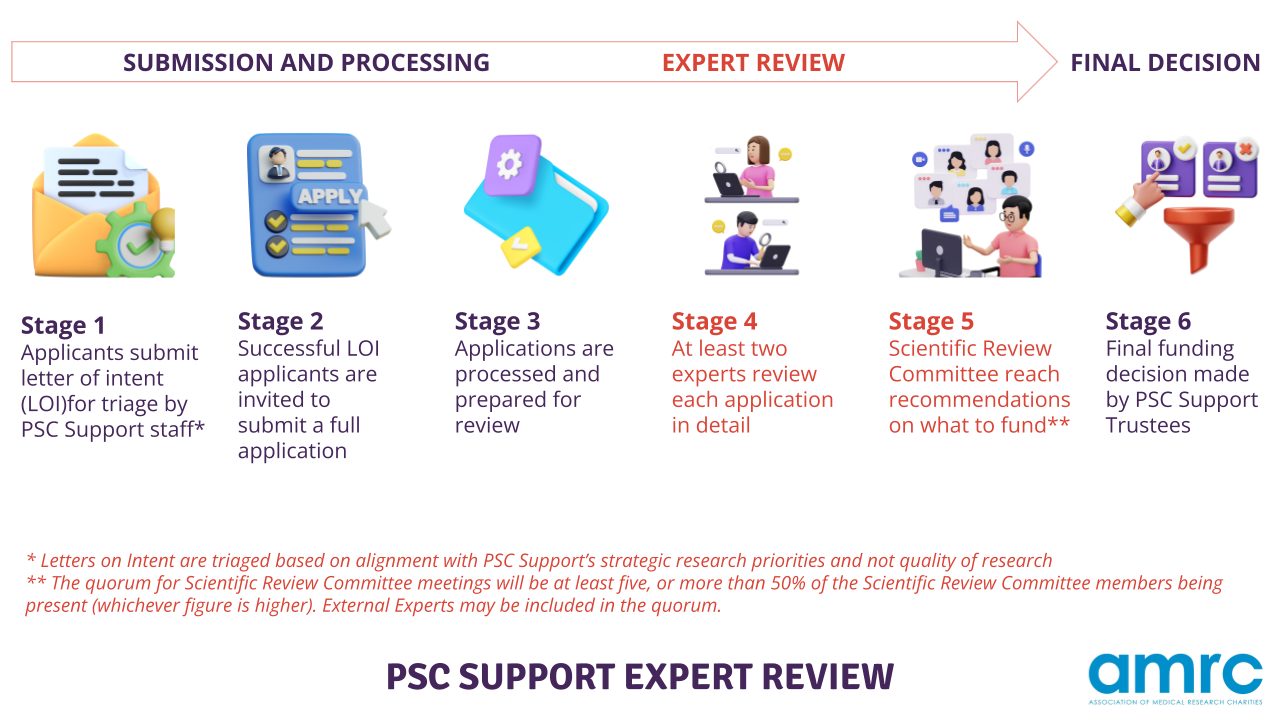
Our Expert Review Process
We aim to complete this process in four to five months.

Our Scientific Review Committee
Our Scientific Review Committee is independent of the charity's staff and trustees.
- Dr Roger Chapman (Chair)
- Dr Luke Boulter
- Dr Emma Culver
- Chris Forde (lay)
- Iain M (lay)
- Ed Sims (lay)
- Professor Douglas Thorburn
- Dr Andrew Yeoman
For each funding application, expert reviewers (at least two scientific experts and two lay experts) will submit written reviews to the PSC Support Scientific Review Committee according to set criteria. The Trustees of PSC Support will approve or deny the awarding of a grant based upon the recommendations of the SRC. Applicants will be notified of this decision in Autumn.
External reviewers will be selected where the Committee does not have sufficient expertise, or where the grant is £55,000 and above. External reviewers may be selected from the wider research and clinical community, or be selected because they have special expertise related to a funding application. PSC Support will work with the Scientific Review Committee to identify appropriate external reviewers.
The Trustees of PSC Support have the final decision regarding funding research projects.
Grants are awarded on the basis of scientific merit and clear relevance to PSC Support’s Research Strategy. The Scientific Review Committee scores the application according to the following criteria:
Scientific Appraisal Criteria Guide
- Relevance of idea or proposal
How the proposal relates to our charity aims and priorities. - Originality
Does the proposal address an important and valid research question? Also refer to PSC Unanswered Questions. - Realistic costing and value for money
Is the budget realistic, value for money and costs justified? - Relationship to and the volume of research already available in the field
Has the proposal considered relevant PSC literature and developments? - Scientific quality or methodology
What is the quality of the experimental design or method? - Expertise of researchers
Does the research team have the right expertise for the proposed research? - Use of animals in research
Funding applications involving the use of animals must comply with the law and support the principle of the 3Rs to refine, reduce and replace the use of animals in research. PSC Support supports the AMRC Statement on Animal Research. Our expectations for responsible use of animals are set out in the document Responsibility in the use of animals in bioscience research.
Lay Appraisal Criteria Guide
The research grant applications are considered by lay reviewers (usually patients) as well as by scientific experts. Lay reviewers will appraise the application based on the relevance and importance of the proposal and on patient and public involvement and engagement
Patients are involved in appraising research applications because PSC Support places great value on the patient voice.
- Relevance of idea or proposal to PSC Support research priorities
How does the proposal relate to our research priorities? - Importance of this research to people with PSC
Does this address an important and valid research question? Refer to PSC Unanswered Questions. - Opinion on patient and public involvement and engagement undertaken so far and proposed during project.
Success rates of eligible applications are as follows:
| Year | Letters of Intent Received | Number of Full Applications Invited | Number funded | Success Rate |
| 2015/16 | — | 3 | 2 | 67% |
| 2016/17 | — | 4 | 2 | 50% |
| 2017/18 | — | 4 | 3 | 75% |
| 2018/19 | — | 1 | 1 | 100% |
| 2019/20 | — | 4 | 3 | 75% |
| 2020/21 | — | COVID | COVID | 0% |
| 2021/22 | — | 1 | 1 | 100% |
| 2022/23 | — | 1 | 1 | 100% |
| 2023/24 | — | 8 | 4 | 50% |
| 2024/25 | — | 17 | 8 | 47% |
| 2025/26 | 19 | 9 | 2 | 22% |
The following list of questions is taken from responses in our PSC Support patient surveys.
Questions about why people get PSC
What is the cause of PSC?
Can PSC be prevented?
What is PSC doing to me?
Who gets PSC?
Why is there such variability between PSCers?
What environmental factors are involved in PSC?
How are genetics involved in PSC?
Are members of my family likely to have PSC?
Can you screen for PSC?
Questions about curing or halting PSC
Can you cure me?
Can you halt the progression on PSC?
Questions about diagnosis, prognosis and identifying PSC risks
How can PSC be diagnosed early?
Why does PSC return after transplant in some people?
What is my prognosis?
Why does PSC progress quickly in some people?
Will I need a transplant?
Identify warning signals that my PSC will be aggressive.
Identify warning signals that I may get a cancer.
Questions about symptoms
Can you understand/treat my fatigue?
Can you understand/treat my itch?
Can you understand/treat my pain?
Does exercise help fatigue in PSC?
Addressing other symptoms.
Questions about helping ourselves
What can I do to stay healthy?
Should I eat a special diet?
How can I improve my mental health?
Questions about PSC and other diseases
How is PSC linked to Inflammatory Bowel Disease (IBD)?
How is PSC linked to other diseases, especially autoimmune diseases?
What is the best treatment regime for PSC-IBD?
What is the role of surgery in PSC-IBD?
Questions about therapies and interventions
Do antibiotics work in PSC?
Does bacterial therapy work in PSC?
What does ursodeoxycholic acid do?
Does vancomycin help people with PSC and/or PSC-IBD?
Can an existing compound or intervention be repurposed to help people with PSC?
Does manipulating the microbiome help in PSC?
Questions about clinical care
How can I get a doctor that understands PSC?
What should I ask my doctor?
What routine tests should I have?
What is the best way to screen for cancers in PSC and/or PSC-IBD?
How should IBD be managed after liver transplant?
How should acute cholangitis be diagnosed?
How can I recognise acute cholangitis?
Will I need a transplant?
What is the best way to deliver a PSC diagnosis?
What is the best way to talk about cancer to a PSC patient?
Research should start as soon as possible after the grant is awarded. Ethical approvals, if required, must be in place before the work commences. All licences relating to research using animals must be valid and in place.
PSC Support is a member of the Association of Medical Research Charities. Provided the study meets the NIHR’s definition of a ‘research study’, the selected project(s) will also be eligible for adoption by the UK Clinical Research Network and therefore will be eligible for NIHR support. For clinical research proposals, applicants are encouraged to contact their local NIHR Clinical Research Network for advice as early as possible.
Any queries relating to submission of the application must be referred directly to PSC Support. Applicants or their colleagues may not contact a Scientific Review Committee member or PSC Support Trustee to discuss any aspect of an application or the decision reached on it.
Additional Information

We've joined a select group of 150 UK charities that have demonstrated best practice in managing research funding and PSC Support is proud to have been approved as a member of the Association of Medical Research Charities (AMRC). The AMRC is a prestigious membership organisation dedicated to supporting medical research charities in saving and improving lives through research and innovation.
Martine Walmsley, PSC Support Head of Research Strategy, said, "To be an approved AMRC member is a real testament to our long-term commitment to invest in the very best PSC research and something we are incredibly proud to have achieved. All of PSC Support's funds come from donations. It is important that our incredible donors and fundraisers can be confident that the research they are helping to fund is not only high quality, but also part of a clear strategic plan towards developing effective treatments for PSC."
AMRC membership demonstrates that PSC Support delivers high-quality research and is an indicator of the excellent work we do in research governance and standards. All members, whatever their size, work to the same high standards to ensure that every penny invested in research is well spent, funding only the very highest quality projects. Universities, government and funding bodies use AMRC membership as an indicator of quality research funding.
PSC Support is an NIHR (National Institute for Health Research) RDN Research Delivery Network (RDN) Non-commercial Partner. This means the studies that we fund may be eligible to access the NIHR Study Support Service which is provided by the NIHR Research Delivery Network within the NHS, and the wider public health and social care environment, across England. Read the full policy: Eligibility criteria for NIHR Research Delivery Network Support.
In partnership with your local R&D office, we encourage you to involve your regional NIHR Research Delivery Network team in discussions as early as possible when planning your study. This will enable you to fully benefit from the support available through the NIHR Study Support Service. Find out more about the Study Support Service.
If your study involves NHS sites in England you will need to apply for Health Research Authority (HRA) Approval. Guidance on submitting an application for approvals is available on the HRA website.
Research costs can be direct and indirect, and charities do not pay indirect costs. We ask that you calculate your costings using AcoRD.
SoECATs
When you complete our full grant application, you must submit a funder export of your SoECAT if you:
- are applying for research funding, and
- will do your research in the UK, and
- need Health Research Authority approval for your study
Why do I need to do a SoECAT?
The SoECAT ensures that costs are attributed in line with the AcoRD principles consistently across the UK.
It helps to produce a full picture of the site-level study activities to understand the resource implications involved for different parties:
- activities that are research costs will be supported by the grant funder
- activities that are service support costs will be supported by the NIHR RDN (if the study is eligible for the NIHR RDN Portfolio) in England
- any excess treatment costs (ETCs) will be supported by the Department of Health and Social Care based on the SoECAT-derived ETC per participant value in England, with payments administered by the NIHR RDN via the National Payment System.
How do I complete a SoECAT?
- Contact your local AcoRD specialist as early as possible in the application process. They can advise on completing the SoECAT and provide a bespoke service to meet the needs of your study. There are different ways to contact an AcoRD specialist, depending on where you are in the UK:
- England: NIHR website
- Scotland: NHS Research Scotland website
- Wales: email research.fundingsupport@wales.nhs.uk
- Northern Ireland: HSC R&D division website
- Complete an online SoECAT. If you do not have an NIHR Central Portfolio Management System (CPMS) account, you will need to create and activate one. Please refer to the NIHR RDN user guide for support with this. Once your account is created and active, you can complete an online SoECAT by selecting the 'Apply for a service for a new study' pathway. Further guidance can be found on the Online SoECAT guidance page.
- Ensure that you have added one or more ‘Research Setting Contacts’ who can review activities related to their setting (e.g. primary care, district general hospital and/or community) and provide valuable feedback. This collaboration strengthens your funding application and helps identify any delivery issues at an early stage to shorten setup times.
- Request authorisation of your SoECAT.
- When you have authorisation, include the ‘funder export’ Excel document from your SoECAT as part of your grant application.
- If we award you a grant, you must access the SoECAT from the ‘My Service Applications' dashboard in CPMS and complete the ‘Submission’ tab of the SoECAT, including uploading the grant award letter, and submitting the SoECAT.
More information
NIHR: Online SoECAT guidance page
NIHR: Online SoECAT guidance module
NIHR: Study Representative Online SoECAT Top Tips infographic
Research Code of Conduct
This Code of Conduct applies to all members of the PSC Support Scientific Review Committee (SRC), external reviewers, applicants and staff/volunteers of PSC Support involved in a funding round.
Confidentiality
Maintaining confidentiality is essential for safeguarding the exchange of scientific opinions and assessments. Details of research applications, related correspondence, and SRC meeting papers are strictly confidential. They must be stored securely and not disseminated to or discussed with anyone outside the review process.
- External reviewers and SRC members must agree to treat all details of applications, scores, and their outcomes as confidential.
- Applicants can expect that details of their applications will not be disclosed to individuals or organisations outside the review process by PSC Support.
- SRC members and external reviewers can expect their appraisals of applications to be treated in confidence by PSC Support. When informing applicants of funding decisions, PSC Support provides anonymised feedback based on reviewers’ comments and SRC meeting summaries. Information that might identify individual reviewers is never disclosed.
- SRC members and external reviewers will be notified by PSC Support of the final funding decisions made by the Board of Trustees for any applications they have evaluated.
Use of Generative Artificial Intelligence (AI)
- PSC Support values the unique perspectives, professional expertise, and independent judgment of its peer reviewers and committee members.
- External reviewers and SRC members must not input, upload, copy, or process any part of a confidential funding application, meeting paper, or review document into external Generative AI tools or platforms (including, but not limited to, ChatGPT, Claude, Copilot, or automated text summarisers).
- The use of Generative AI to draft peer review critiques, synthesise application content, or generate assessment feedback is strictly prohibited. All reviews and comments submitted to PSC Support must represent the reviewer's own original analysis and expert judgment.
- Inputting application materials into third-party AI platforms constitutes a direct breach of confidentiality, UK GDPR, and applicant intellectual property rights.
Conflicts of Interest
- Any external reviewer or member of the SRC who declares a conflict of interest (including a current association with an institution applying for a grant) will not participate in the assessment of that proposal. They will not receive the relevant application documents (s) and will be absent from discussions regarding that submission during SRC meetings.
Communication Rules
- Applicants (including Co-Applicants, and host institution representatives) must not attempt to contact members of the SRC or external reviewers directly regarding an active or pending application.
- SRC members and external reviewers must not contact applicants directly regarding any application under assessment. All evaluations, questions, or requests for clarification must be channeled through official PSC Support communication channels.
ResPol1.4
PSC Support is committed to embedding the patient voice in research. We strongly encourage applicants to involve patients early in study design. Our dedicated Patient Panel may be able to support researchers in this way.
We support the AMRC position statement on the importance of involvement in medical research
If you are a researcher and would like some support involving people affected by PSC in your research, please complete our Request for Support form.
Supporting PPIE in Research Applications and Managing Conflicts of Interest (Ref: ResPol7)
PSC Support is committed to accelerating research into primary sclerosing cholangitis (PSC) and improving care for everyone affected by the condition. Meaningful Patient and Public Involvement and Engagement (PPIE) ensures research is designed around the real needs, priorities, and lived experiences of people with PSC.
To support researchers while maintaining complete fairness and transparency across our research grant funding programme, we operate under the following clear guidance regarding application support and conflict management:
How We Support Researchers with PPIE
We actively encourage researchers to involve patients and members of the public at the earliest stages of study design. Request support here.
How We Avoid and Manage Conflicts of Interest when the Research is Funded by or being Evaluated for Funding by PSC Support
To ensure our research grant evaluation process remains rigorous, independent, and impartial, we set clear rules to manage conflict of interest when providing PPIE support:
- PPIE Advice: Any patient representative or lay member who assists a researcher in developing their PPIE plan for research that is being evaluated for funding by PSC Support (including reviewing lay summaries or advising on study design) is excluded from reviewing or scoring that specific grant application for PSC Support.
- Independent Review Panels: All research applications submitted for PSC Support funding are evaluated by independent scientific reviewers and patient reviewers who have had no prior involvement with the proposed study.
- Advisory Roles vs. Trial Governance: To maintain objectivity, PSC Support charity staff do not take voting seats on the trial steering committees or formal governance boards of projects funded directly by the charity. Charity staff or designated patient representatives may participate in project committees or advisory groups in an advisory, non-voting capacity.
Through these measures, we ensure researchers receive high-quality PPIE support to build stronger studies, while our community can trust that every grant we fund is reviewed fairly and impartially.
If you have PSC, or someone close to you does, and you'd like to get involved in research, we'd love to hear from you. Please let us know here.
PSC Support follows the AMRC principles in the use of Animals in Research
We support the AMRC statement on animal research.
Use of Animals Policy
PSC Support appreciates that research using animals plays an important role in the research process and we support the principle of using animals when it is necessary
- to advance the understanding of primary sclerosing cholangitis and associated conditions.
- to develop treatment when there is no alternative that can be used to find out the same information without using animals.
PSC Support will only fund research involving live animals when this is essential to the outcome of the research, there is no alternative method of obtaining the data, and when pain and distress to animals is minimised.
We use expert peer review to ensure that we fund only high quality research where the benefits to human health outweigh any harm to animals. The use of animals must be fully justified in all applications for research grants.
PSC Support requires that all experiments should be carried out with due concern for the welfare of the animals, and using the minimum number necessary to provide clear data in well-designed experiments.
Individuals working on experiments using animals must have a personal licence and the institution must also have an establishment licence.
High standards of animal welfare are important. These both minimise discomfort for the animals involved and enable researchers to get reliable results. We only fund research which complies with the law and support the principle of the 3Rs to refine, reduce and replace the use of animals in research:
- Replace the use of animals with alternative techniques, or avoid the use of animals altogether
- Refine the way experiments are carried out, to make sure animals suffer as little as possible. This includes better housing and improvements to procedures which minimise pain and suffering and/or improve animal welfare.
- Reduce the number of animals used to a minimum by seeking ways to find out information from fewer animals or more information from the same number of animals.
PSC Support accepts that not all of the public can accept research using animals.
Our PSC Support Agreement for grant research awards specifically refer to the ethical use of animals. Our requirements are that:
1.1. A project involving the use of animals may not be commenced in the absence of Home Office licences covering all relevant institutions the researchers and the research activity. Acceptance of an award constitutes confirmation that any necessary consent including Home Office approval under the Animals (Scientific Procedures) Act 1986 or other relevant legislation has been obtained. Grant holders are expected to adopt procedures and techniques which minimise the use of animals.
1.2. Research using animals plays an important role in the research process and PSC SUPPORT supports the principle of using animals when it is necessary to advance the understanding of Primary Sclerosing Cholangitis and associated conditions to develop treatment when there is no alternative that can be used to find out the same information without using animals. Expert peer review is used to ensure that we fund only high quality research where the benefits to human health outweigh any harm to animals. PSC SUPPORT supports the Association of Medical Research Charities statement on animal research.
1.3. All experimental programmes supported by PSC Support must only use animals were there are no alternatives.
1.4. Experiments using animals funded by the PSC Support must:
1.4.1. use the simplest possible, or least sentient, species of animal
1.4.2. ensure that distress and suffering are avoided wherever possible
1.4.3. employ an appropriate design and use the minimum number of animals consistent with ensuring that the scientific objectives will be met
1.5. See the NC3Rs website for further information and guidance.
1.6. All grant holders using animals must implement the principles in the cross-funder guidance Responsibility in the Use of Animals in Bioscience Research.
1.7. Grant holders using non-human primates must comply with the NC3Rs guidelines Primate Accommodation, Care and Use.
1.8. Grant holders should make use of the ARRIVE guidelines when designing their experiments, and ensure that they report animal-based studies in accordance with the ARRIVE guidelines as far as possible, taking into account the specific editorial policies of the journal concerned.
ResPol4.2
As a member of the AMRC, PSC Support follows the Research Funders Policy Group joint statement on the use of generative AI tools in funding applications and assessment.
Generative AI tools offer potential benefits for research but also challenges and risks. The joint statement sets consistent standards on generative AI tools in funding applications and assessment across research funding organisations in the UK. It makes clear that AI technology should not be used for peer review and that, if used in other contexts, such as preparing funding applications, it must be clearly cited and acknowledged.
PSC Support Guidance on the Use of Generative Artificial Intelligence (AI)
PSC Support supports the principles set out in the June 2026 Funders Joint Statement on Generative AI. We recognise that generative AI tools can support researchers in preparing high-quality grant applications, provided they are used responsibly, ethically, and transparently.
Acceptable Uses of Generative AI
Generative AI may be used as a supportive tool during application development. Examples of acceptable use include:
- Translating application text from other languages into English.
- Improving language clarity, grammar, or general standards of written English.
- Formatting text or editing content to adhere to character and word count limits.
- Assisting with preliminary idea generation or the development of hypotheses.
- Interpreting, analysing, or summarising data, literature, audio, or image files.
- Comparing literature sources and synthesising published findings.
- Generating or refining computational code and analytical scripts.
- Assisting in drafting summaries or abstracts.
Prohibited Uses of Generative AI
Applicants must not use generative AI tools in any manner that breaches standard research integrity expectations.
Prohibited practices include:
- Fabricating, falsifying, manipulating, duplicating, or altering original data, images, or research results.
- Plagiarism - using third-party ideas, intellectual property, or text without appropriate attribution or permission.
- Breaching UK GDPR, data protection regulations, or third-party intellectual property rights (e.g. uploading confidential data into unsecure public tools).
- Misrepresenting or falsifying personal information, qualifications, or track records.
- Generating false or fabricated citations, references, or literature sources.
- Generating an entire application, or complete sections of an application, without substantive human input, editing, and critical oversight.
Applicant Accountability
Applicants and the co-applicants retain sole responsibility for the accuracy, scientific validity, and integrity of all content submitted.
Declaring the use of generative AI is for transparency only and will not negatively impact the assessment or peer review of your application.
See also Code of Conduct (Research) above for details of reviewer obligations.
PSC Support follows the AMRC Statement on Supporting Research in Universities
As a member of AMRC, PSC Support endorses the principles of the AMRC Statement on Supporting Research in Universities.
Key principles
- AMRC charities remain committed to supporting research and the careers of talented researchers in UK universities;
- AMRC believes that government is primarily responsible for provision of underpinning funding for the UK biomedical science base;
- Where it is within their charitable objects and appropriate for them to do so, AMRC encourages its member charities to contribute towards a sustainable science base in universities through the support of longer-term funding for people and facilities;
- Universities should understand the full economic costs of proposed research facilities or activities when seeking financial support from charities;
- Charities will not normally meet the full economic costs of the research they are supporting, especially for responsive mode funding calls;
- Universities will be expected to contribute resources from QR, including the charity support element, in order to meet the full costs of research in partnership with charities;
- Charities will not contribute a percentage overhead towards general university infrastructure;
- Charities are unlikely to respond positively to demands to fund research activity on the basis of a fixed percentage of research costs (as is the case for other funders including the Research Councils); and
- AMRC will work with member charities, government and universities to develop new models of partnership funding that will enable charities of all sizes to develop their commitment to research in a sustainable way.
ResPol5.1
Where there is a potential conflict of interest, the reviewer, member or Trustee shall not be party to any decision or have sight of the application form. Please see our Conflicts of Interest Policy.
Got a question?
If you have any questions regarding our funding, please get in touch.
Applicants sometimes contact us to ask informally about the appropriateness of their application and seek advice about our remit. Such enquiries are dealt with by charity staff who are not scientific experts and will only advise if an application isn’t suitable for funding when it is clearly outside our remit. Charity staff will not comment on likelihood of securing funding from PSC Support because all applications must go through the independent peer review process prior to any decisions about funding.