
What liver research gap did this study address?
Primary sclerosing cholangitis (PSC) is a chronic liver disease that damages and narrows the bile ducts, which carry bile from the liver to the small intestine. The bile helps the digestion of food in the gut, it’s reused by the body but part of it comes out with the stools. In advanced PSC, liver transplantation is currently the only treatment. However, PSC can sometimes return in the transplanted liver, known as recurrent PSC (rPSC).
Previous studies reported different frequencies for recurrence and suggested several factors that may be associated with rPSC. This study brought together the available evidence from around the world to help us understand better how often PSC recurs after liver transplantation and also to identify factors associated with recurrence.
What were the aims of this PSC study?
Our study aimed to answer two main questions:
- How often does PSC recur after liver transplantation?
- Which patient, clinical, medication or transplant-related factors are associated with a higher risk of recurrence?
We also wanted to see if different geographical regions also played a role in recurrence of PSC after liver transplant.
How was the research conducted?
We performed a systematic review and meta-analysis. This means that we searched the medical literature for relevant studies and combined their results using statistical methods.
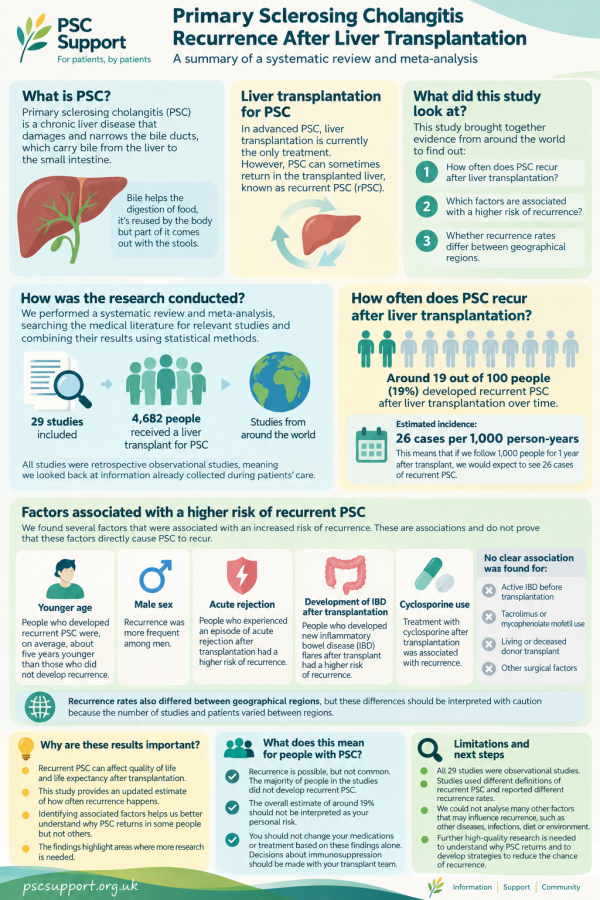
In total, 29 studies involving 4,682 people who received a liver transplant for PSC were included. All of the included studies were retrospective observational studies, meaning that we looked back at information that had already been collected during patients' care, rather than assigning patients to different treatments. We also examined several possible factors associated with recurrent PSC.
What were the main findings of the study?
Overall, PSC recurred in approximately 19 people out of 100 people after liver transplantation over time, although this was an average across studies because the frequency of recurrence varied considerably.
The estimated incidence of recurrence was 26.04 cases per 1,000 person-years. This is a way of accounting for both the number of people studied and how long they were followed. In essence, if we follow 1000 people that received a liver transplant for PSC for 1 year, we would expect to identify 26 cases of rPSC.
We found that several factors were associated with recurrent PSC:
- Younger age: people who developed recurrent PSC were, on average, about five years younger than those who did not develop recurrence.
- Male sex: recurrence was more frequent among men in the studies included in the analysis.
- Acute rejection: people who experienced an episode of acute rejection after transplantation had a higher risk of recurrence. Acute rejection happens when the immune system of the person attacks the new liver, usually within 1 to 3 months from the transplant. It’s characterised by flu-like symptoms, fever and jaundice. The treatment is often with intravenous steroids and requires adjustment of the immunosuppressive drugs used after transplant.
- Development of IBD after transplantation: people who developed new inflammatory bowel disease (IBD, such as ulcerative colitis and Crohn’s disease) flares following transplantation had a higher risk of recurrent PSC.
- Cyclosporine use: treatment with cyclosporine after transplantation was associated with recurrence.
Importantly, these findings show associations rather than proof that these factors directly cause PSC to recur. For example, being younger or male does not mean that an individual will necessarily develop recurrent PSC. Similarly, experiencing rejection does not mean that recurrence is certain.
We did not find clear evidence of an association with recurrent PSC for several other factors, including active IBD before transplantation, tacrolimus or mycophenolate mofetil use, receiving transplantation by a living or deceased donor, and other surgical factors.
The study also found differences in recurrence rates between geographical regions. However, these differences should be interpreted with caution because the number of studies and patients varied between regions.
Why are these results important for PSC?
Understanding recurrence of PSC is important because it impacts on the quality of life and life expectancy after liver transplantation.
The finding that PSC recurred in around one in five patients that received a transplant provides an updated estimate of how frequently this happens across the available international evidence. Identifying factors associated with recurrence also helps us, as researchers and doctors, better understand why PSC returns in some people but not others.
The study also highlights areas where more research is needed. Most importantly, the evidence available today does not allow us to say that changing one particular factor will prevent recurrent PSC.
For example, although cyclosporine use was associated with recurrence, this study cannot establish that cyclosporine itself is worse than other drugs, such as tacrolimus or mycophenolate, after transplant. On top of the different immunosuppressive drugs used after transplants, there are many other factors that can increase or decrease the risk of rPSC, such as other diseases, infections, diet and environment, and we could not analyse these in our study.
What does this mean for people with PSC?
For someone who has had a liver transplant because of PSC, these results show that recurrence, although possible, is not common. The majority of people in the studies did not develop recurrence of PSC.
The overall estimate of around 19% should not be interpreted as personal risk. It may differ depending on factors such as follow-up time, clinical characteristics and how recurrent PSC was defined in each study (if only based on MRI scans or based on liver biopsies).
People should not change their medications or treatment based on these findings alone. Immunosuppressive treatment after transplantation is essential, and decisions about which medicines to use should be made alongside the transplant team based on each individual's circumstances. Patients should have access to the right information so that they can discuss their treatment with their doctors, and make shared and informed decisions.
The study has some limitations. All 29 studies were observational, and they used somewhat different definitions of recurrent PSC and reported substantially different recurrence rates. Although these findings provide a useful picture of recurrent PSC based on the evidence currently available, further high-quality research is needed.
Ultimately, understanding why PSC returns after transplantation may help us improve long-term monitoring and, in the future, develop strategies to reduce the chance of recurrence.
Many thanks to Isabelle Castro Vitor for this summary.