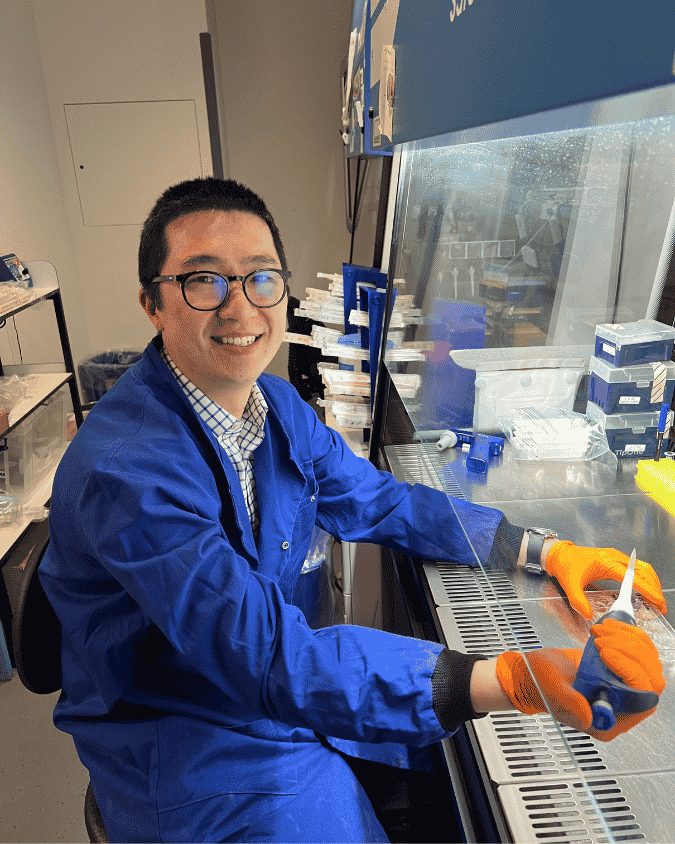
Dr James Sun
Genetic changes in the bile ducts in PSC

Awarded to Dr James Sun, The Francis Crick Institute
The total grant awarded is £15,000
Duration of award: 09 months (February 2025 to October 2025)
Research title: Genetic changes in the bile ducts in PSC

Summary
PSC Support has awarded £15,000 to Dr James Sun to study how cells in bile ducts change in PSC. This project will be the first study to identify the genetic changes in bile duct cells in people with PSC. Dr Sun will explore the biological impact of these genetic changes using an artificially created bile duct, known as “organoids” – a way of growing cells in 3D in the laboratory.
This study is known as a “pilot study”, which means it is the very first investigation using state of the art technology that is designed to test whether, and how, a further, full study can be undertaken.
What will Dr Sun do?
In this pilot study Dr Sun will apply state of the art DNA sequencing technology to identify genetic changes in bile duct cells. He will separately develop a laboratory 3D cell model called organoids that will be used to study the biological effect of the genetic changes he identifies and determine how they alter the behaviour of bile duct cells.
Why is this study important?
This pilot study could provide us with a detailed understanding of the biological processes involved when bile duct cells become diseased. The aim is to develop a larger study with potential to benefit patients in two ways:
- Identify new drug targets in the cell changes discovered to delay or reverse progression of PSC
- Lead to the development of genetic tests that identify which patients are at higher risk of progression or cancer development in PSC
Progress Report
PSC patients undergoing camera tests and having transplants have been recruited into the study. The 3D model system that will be used to investigate the genetic changes has been set up. Work is ongoing to conduct DNA sequencing to detect the genetic changes. The team is deciding on the best technique to use to achieve meaningful results.
Dr James Sun, August 2025
Congratulations Dr Sun!
We are delighted to share how small grants create massive waves in medical research. Dr James Sun has successfully used preliminary data from a seed funding study funded by PSC Support to secure a prestigious Clinical Research Training Fellowship from the Medical Research Council (MRC).
This fellowship will enable him to pursue an in-depth PhD project focused on identifying the genetic drivers behind primary sclerosing cholangitis.
"This will allow me to delve deeply into my project, develop technical research skills and my scientific approach to clinical problems... I hope to be able to improve our understanding of PSC to enable us to identify potential new treatments."
Dr James Sun, June 2026


Research Update (October 2026)
This early-stage study has shown that it is possible to obtain high quality whole genome sequencing data from the bile ducts of patients with primary sclerosing cholangitis (PSC), at both early and advanced stages of the condition. Using a technique called laser capture microdissection, individual groups of bile duct cells (cholangiocytes) can be precisely isolated from liver tissue sections for analysis.
Although the data analysis is still in progress, the results so far are encouraging. As expected, cells from older individuals carry more somatic mutations — the small DNA changes that accumulate over a lifetime — confirming the approach is picking up genuine biological signals. The study has also found that mutation levels can vary between bile duct samples taken from different parts of the same patient's liver, suggesting the disease does not affect all areas of the liver equally.
In parallel, the team has successfully grown bile duct organoids — miniature, lab-grown models of bile ducts — derived from both patient tissue and induced pluripotent stem (iPS) cells. These organoids have been validated as biologically authentic: they express the correct marker genes and proteins and carry out the biochemical functions expected of real bile duct cells. This makes them a reliable system for investigating what happens inside cells when specific somatic mutations are present, enabling future work to establish whether individual mutations change cell behaviour.
Mission 2030 is an ambitious challenge and we can’t do it alone. We need your help to find the breakthrough people with PSC so desperately need.
It’s time we found effective treatments for PSC
Play your part in leaving no stone unturned
Make a donation to research and all the other things we do to help people affected by PSC