July 2026 Research Roundup
Research Roundup
July 2026

Welcome to our July research roundup, where we’re sharing updates that are shaping the future of care for everyone affected by PSC.
What does recent research mean for people with PSC?
Primary sclerosing cholangitis (PSC) is a rare, complex liver disease causing inflammation and strictures in the bile ducts. Because individual disease courses vary, managing symptoms and anticipating progression present unique challenges. Today, no approved medical therapies exist to slow or halt PSC progression. However, recent developments are moving us forward.
Ask the Experts!
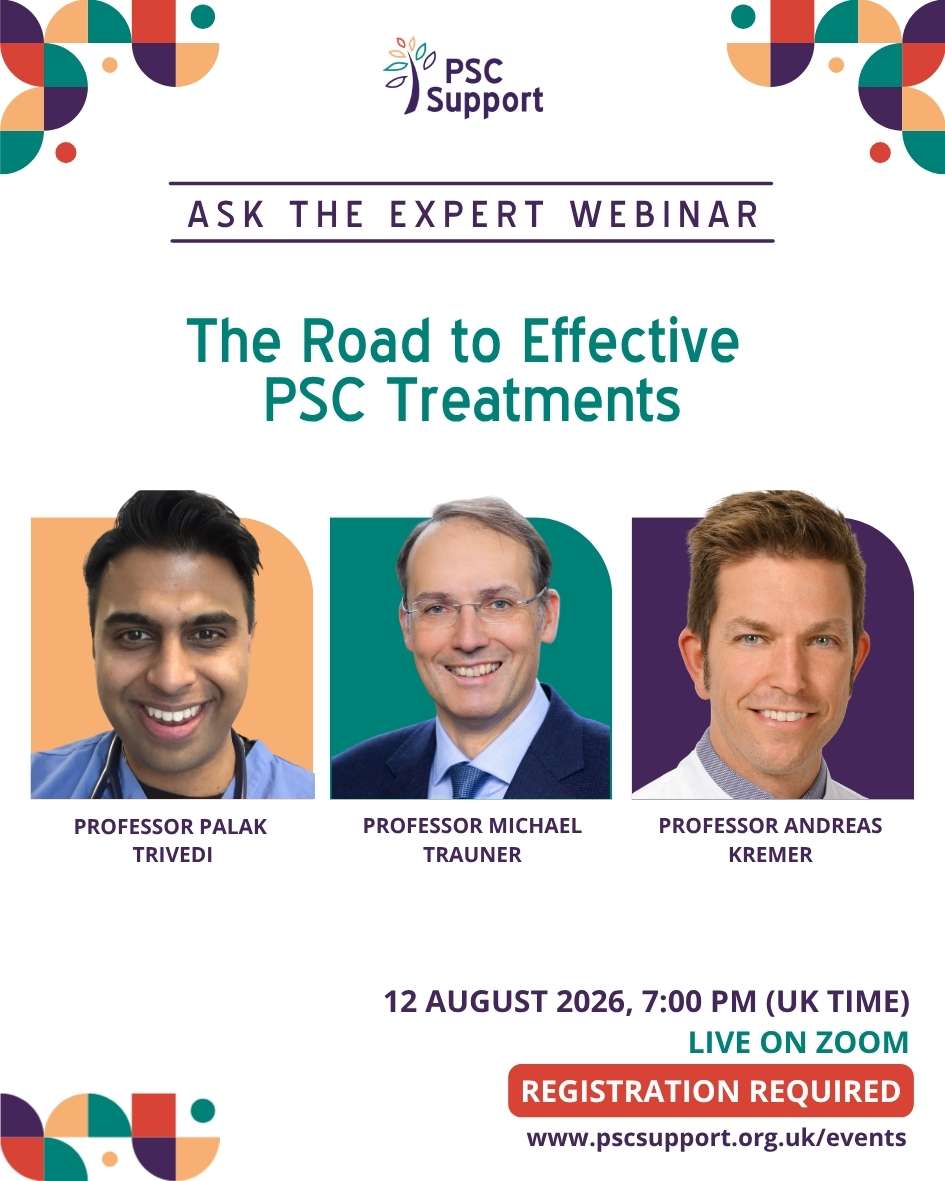
Join us at 7pm on 12 August for a very special Ask the Expert webinar all about the road to getting an effective treatment or treatments for PSC. Professor Palak Trivedi, Professor Michael Trauner, and Professor Andreas Kremer will join us to discuss this important topic.
For joining details, please register.
How is the UK regulatory framework changing for rare diseases like PSC?
The UK’s medicine regulator, the Medicines and Healthcare products Regulatory Agency (MHRA), recently proposed a new ‘Rare Disease Therapies Regulatory Framework’. Designed to overcome standard clinical trial barriers, the framework offers flexible decision-making, earlier regulatory dialogue, and integration of real-world evidence to accelerate drug development.
However, the proposed criteria include a prevalence (how many people have the disease) threshold of 1 in 50,000. PSC Support has responded to the MHRA consultation to advocate for our community. While PSC affects approximately 5.6 to 10 in 100,000 individuals in the UK, excluding complex conditions based strictly on prevalence risks leaving patients without options. PSC Support is urging the MHRA to base eligibility on high unmet medical need, alongside streamlined processes for drug repurposing and formal patient involvement.
What do new findings show about fibrate therapy for PSC?
A 2026 study looking back at health records (a ‘retrospective’ study) evaluated long-term add-on fibrate therapy in 34 individuals with PSC taking ursodeoxycholic acid (UDCA). In patients with early-stage disease, adding fibrates was linked to reductions in both persistent itch (pruritus) and alkaline phosphatase (ALP), a key marker of bile duct function.
While these results suggest fibrates may improve bile flow, markers of later-stage liver damage did not decrease. Retrospective record reviews carry potential for bias and lack a control group; therefore, these findings cannot directly change clinical practice. We’re eagerly awaiting published results from recently completed Phase 3 clinical trials to determine whether fibrate therapy offers a proven, disease-modifying treatment for PSC.
Can blood tests like vitamin B6 predict PSC progression?
Predicting which individuals face higher risk of liver disease progression or requiring a liver transplant remains a central goal in liver medicine today. A 2026 multi-centre study examining patient cohorts across Norway, Germany, and the USA revealed that vitamin B6 deficiency was present in 38% of participants with PSC.
The research team observed that low blood levels of vitamin B6 was associated with higher ALP and bilirubin levels, as well as increased likelihood of advanced liver damage, liver transplant, or death. This study evaluated vitamin B6 solely as a marker to predict disease progression. It provides no evidence that taking vitamin B6 supplements alters the course of PSC. You should always consult their PSC doctor before making any dietary changes or starting new supplements.
How is PSC Support funding future research?
To help address unmet needs in our community, PSC Support has opened its 2026 Research Grant Round. Available funding includes Seed Funding Awards (up to £15,000 each) to establish proof-of-concept data and a Project Grant (up to £50,000) for basic, clinical, or translational studies.
All proposals must align with strategic priorities set out in our Research Strategy, focusing on PSC, recurrent PSC (rPSC), cholangiocarcinoma (CCA), or PSC-associated inflammatory bowel disease (PSC-IBD).
We hope these updates bring you encouragement as research moves forward. Please get in touch if you have any questions:
Martine Brown
PSC Support Head of Research and Policy
ERN RARE-LIVER Management Board and PSC Working Group Co-Lead